If you’re searching for practical ways to stay active during long workdays, you’re in the right place. Sitting for hours can drain your energy, tighten your muscles, and quietly impact your long-term health. This article is designed to help you counteract those effects with simple, effective strategies you can use right at your workstation.
We’ll walk you through science-backed movement techniques, posture resets, and desk exercises for office workers that improve circulation, reduce stiffness, and boost daily performance—without disrupting your workflow. Whether your goal is easing back pain, increasing focus, or supporting overall wellness, these exercises are tailored for busy professionals who need results without complicated routines.
Our recommendations are grounded in established fitness principles and recovery strategies used by performance and wellness experts, ensuring you get advice that’s both practical and effective. Let’s turn your desk into a space that supports your health, not works against it.
Eight hours at a desk can leave your hips tight, shoulders hunched, and energy flatlining by 3 p.m. I’ve felt that slow, nagging back pain myself, and I don’t think it’s something we should just “push through.” Small, intentional movements matter. This guide delivers simple, discreet desk exercises for office workers you can do without leaving your chair.
- Boost circulation
- Reset posture
- Rekindle focus
These low-impact habits support circulation, alignment, and steady energy throughout the day. In my view, consistency beats intensity; sustainable, daily action fuels long-term wellness and performance. Think marathon, not sprint, with your body. Every day counts.
Why Your Desk Is a Hidden Health Hazard
We sit more than we sleep. That’s a problem. Sedentary physiology—the study of how prolonged sitting alters normal body function—shows that extended inactivity slows muscle activity, circulation, and metabolic processes (American Journal of Physiology, 2010). In other words, your chair quietly rewires your health.
1. Postural Collapse
Hours of slouching weaken the posterior chain—the muscles along your upper back, glutes, and hamstrings that keep you upright. As they switch off, your neck and shoulders overwork (hello, 3 p.m. stiffness). Over time, this imbalance fuels chronic back pain.
2. Metabolic Slowdown
When large leg muscles stay idle, blood sugar regulation drops and circulation slows (Mayo Clinic). That energy crash? Not just boredom.
3. Joint Stiffness
Tight hip flexors pull the pelvis forward, straining the lower back and limiting mobility.
Incorporating desk exercises for office workers restores circulation, reactivates muscle fibers, and protects long-term joint health.
Upper Body Savers: Relieving Neck, Shoulder, and Wrist Strain
Think of this as your first line of defense against “tech neck” and typing fatigue—the modern aches that creep in after hours at a screen (yes, even if your posture “isn’t that bad”). These simple desk exercises for office workers target the areas that tighten first.
1. Cervical Glides (Chin Tucks)
A cervical glide realigns your head over your spine. Sit tall. Gently draw your chin straight back as if you’re making a double chin. Hold 5 seconds. You should feel a stretch at the base of your skull—not pain. Repeat 8–10 times. This counters forward head posture, where the head juts ahead of the shoulders.
2. Seated Scapular Retractions
“Scapular” refers to your shoulder blades. Sit upright and pinch your shoulder blades together. Hold 5 seconds, release slowly. Repeat 10 times. This activates upper back muscles that weaken with slouching.
3. Wrist Flexor & Extensor Stretches
Extend one arm, palm up. Gently pull fingers back to stretch the inner forearm. Switch palm down to stretch the outer forearm. Hold 15 seconds each.
4. Overhead Triceps Stretch
Raise one arm overhead, bend the elbow, and gently press it back. Hold 20 seconds.
• Move slowly and breathe steadily.
• Stop if you feel sharp or radiating pain.
Building a Stronger Foundation: Core and Lower Back Support
“Why does my back ache by 3 p.m.?” a client once asked. The answer wasn’t dramatic. “Because your core checked out at noon.”
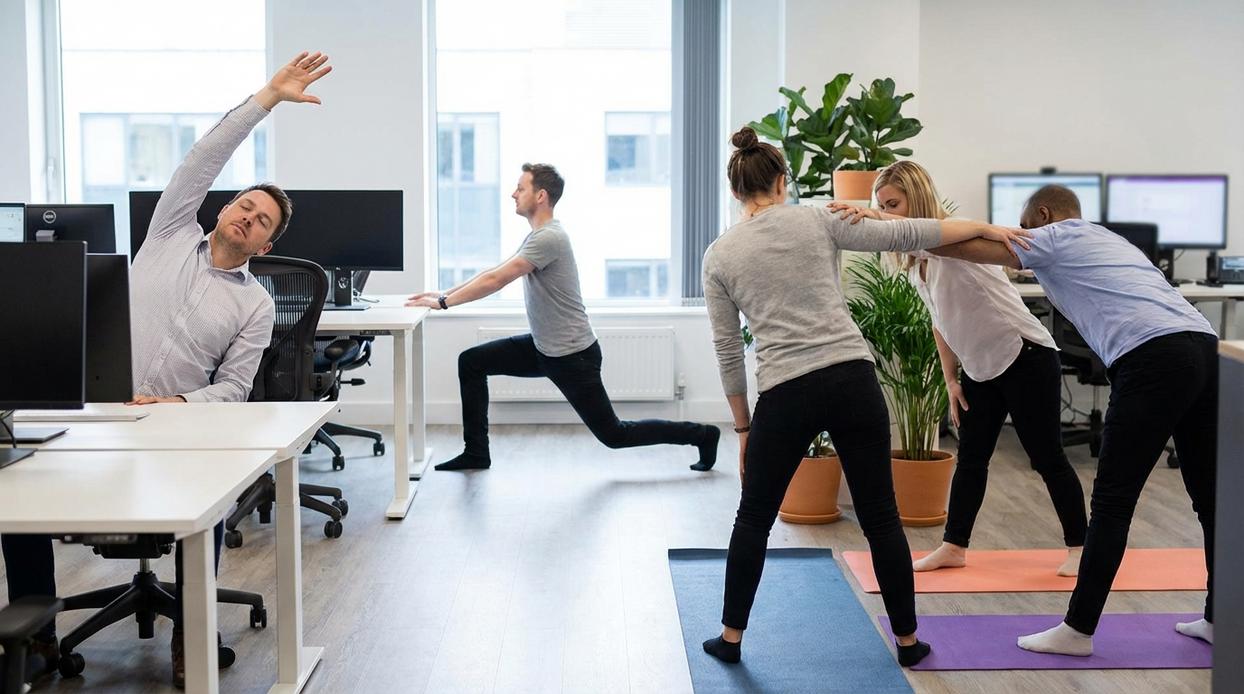
Your core—the muscles around your abdomen, hips, and lower back—acts like a built-in brace. When it’s inactive, your lumbar spine (lower back) absorbs the strain. These desk exercises for office workers are subtle, effective, and invisible to coworkers (yes, even during Zoom calls).
-
Abdominal Bracing
Sit tall. Inhale. Tighten your midsection as if preparing for a punch. Hold 10–15 seconds while breathing lightly, then release. Repeat 5 times. “Think armor, not sucking in,” I often say. -
Seated Cat-Cow
Hands on knees. Inhale, arch your back and lift your chest (Cow). Exhale, round your spine and tuck your chin (Cat). Move slowly for 8–10 reps. Controlled motion gently mobilizes stiff vertebrae. -
Glute Squeezes
Contract your gluteal muscles for 5 seconds, release, repeat 10–15 times. Sitting turns them “offline.” This wakes them up. -
Seated Pelvic Tilts
Rock hips forward to arch slightly, then backward to flatten your lower back. Repeat 10 times to ease lumbar pressure.
Pro tip: Pair these with habit stacking how to make daily fitness automatic to stay consistent.
Lower Body Wake-Up Call: Boosting Circulation and Mobility
Sitting for hours creates an A vs B scenario: Option A—stay still and let blood pool in your lower legs, leading to stiffness and swelling. Option B—add brief movement and keep circulation flowing efficiently. Blood pooling (when blood collects in the lower extremities due to gravity and inactivity) can leave you feeling heavy and sluggish by mid-afternoon.
The fix? Simple movement snacks. Use desk exercises for office workers in the section once exactly as it is given.
- Ankle Rotations: Lift one foot slightly off the floor. Draw slow circles clockwise for 10 reps, then counterclockwise. This lubricates the ankle joint (synovial fluid increases with motion) and reduces stiffness.
- Seated Leg Extensions: Straighten one leg until parallel to the floor. Squeeze the quadriceps (front thigh muscles) and hold 3–5 seconds. Lower slowly. Alternate sides.
- Heel and Toe Raises: With feet flat, lift heels while keeping toes down, then reverse. The calf muscles act as a “second heart,” pushing blood upward.
- Seated Marching: Lift one knee at a time, engaging your core for stability.
Stillness tightens. Movement restores. (Your legs weren’t designed to hibernate under a desk.) Pro tip: Set a 30-minute timer to stay consistent.
Creating Your Desk-Fit Routine
Last year, I noticed my back aching by 3 p.m., so I built a simple system instead of chasing random stretches. Here’s what worked.
Try the Pomodoro Plus method: during each five-minute break, do one of your favorite desk exercises for office workers. It keeps momentum without breaking focus (and feels oddly energizing).
Next, use habit stacking: after every sent email, perform five shoulder rolls.
Sample 2-Minute Reset
Stand for calf raises, stretch your chest, then finish with neck tilts. Pro tip: set a subtle timer. Consistency beats intensity. Start small and adjust weekly. Track progress.
Office work keeps you sitting for hours but small consistent movements compound into REAL long-term health gains The problem is sedentary routines the solution is integrating micro-movements daily Try desk exercises for office workers to boost circulation and focus Choose one exercise from this list and do it right now.
Take Control of Your Energy and Performance Today
You came here looking for practical ways to improve your health, boost performance, and recover smarter—without overhauling your entire life. Now you have the strategies to make that happen.
Ignoring fatigue, stiffness, and inconsistent routines only makes progress harder. Whether it’s integrating desk exercises for office workers, optimizing recovery, or fine‑tuning daily movement habits, small intentional actions create lasting results. Your body responds to consistency—and the longer you wait, the more energy and performance you leave on the table.
The next step is simple: choose one strategy from this guide and implement it today. Then build from there. When you’re ready to go deeper, explore more expert-backed wellness insights and performance strategies designed to help you move better, feel stronger, and recover faster.
Don’t settle for burnout and plateaus. Take action now and start building a healthier, higher-performing version of yourself today.